
An international team of scientists, LUX-ZEPLIN (LZ), has detected an intriguing signal that could hint at evidence of dark matter, offering a clue that might bring the mystery of the elusive substance one step closer to a solution. The recently published LZ study found one particle interaction that is difficult to explain with known background processes and could potentially have been caused by a WIMP.
A member of the LZ team, Professor Kimberly Palladino, Lincoln Tutorial Fellow in Physics, shares the findings.
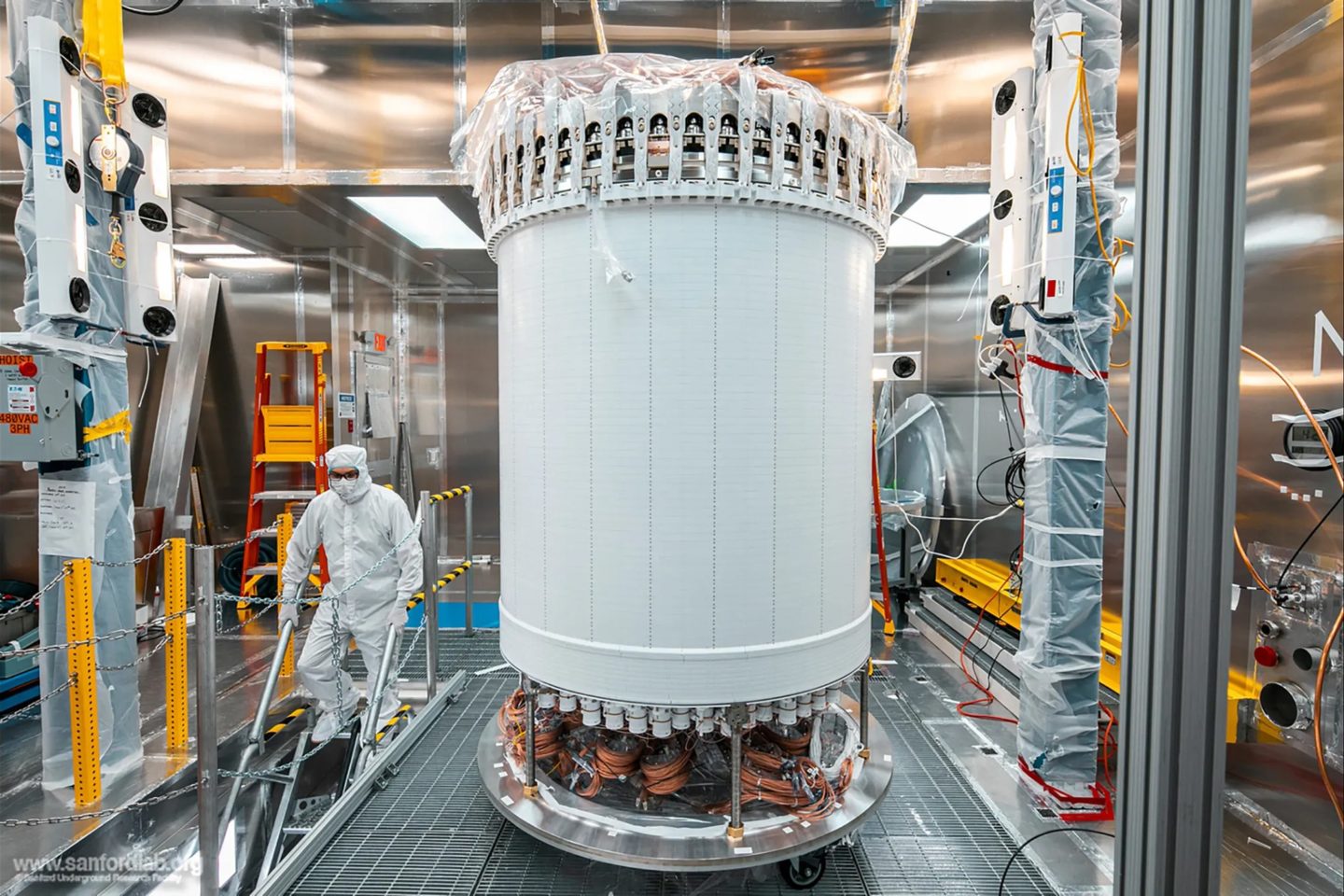
The LUX-ZEPLIN main detector in a surface lab before installation underground.
As a student in the sciences, I was surrounded by classmates talking about the latest sci-fi novel they were devouring, whilst I happily immersed myself in cosy mysteries. Thus, I felt at home as my career brought me to Oxford, a city steeped in literary and film mysteries, and I recognised that stories about detectives had much more to do with my research than robots and time travel.
The big mystery I've devoted myself to is dark matter, an as-yet undetected material that shapes our universe via gravity, but does not interact with light or charge. For the better part of a century, people have been trying to understand dark matter. This invisible substance makes up roughly 85% of the mass in the universe. Determining exactly what it is remains one of the biggest questions about our world.
The detective side of our jobs as astrophysicists is collecting clues in different areas and bringing them together to make a complete picture of dark matter. We have a number of suspects for what dark matter can be, and we are seeking the evidence to fully identify it.
I work on LZ, or LUX-ZEPLIN, an international collaboration of 250 scientists and engineers from 39 institutions. The detector operates nearly one mile below ground at the Sanford Underground Research Facility (SURF) in South Dakota, USA. It uses 10 tonnes of ultrapure liquid xenon to search for dark matter and is optimised to look for WIMPs, or weakly interacting massive particles.
Now, a newly released analysis has resulted in a single particle interaction that we have great difficulty explaining with known background signals from normal matter. The result does not yet meet the statistical threshold required to claim a discovery, but is the most compelling hint of dark matter seen in a liquid xenon detector to date.
The results were presented in a scientific talk at the 2026 TeV Particle Astrophysics Conference in Japan. The paper will be released on the online repository arXiv and submitted to the journal Physical Review Letters.
“We’re very intrigued to see this event in the data, in the region where we expect dark matter to show up and the competing backgrounds are very low,” said Rick Gaitskell, a professor at Brown University and the spokesperson for LZ. “With only one event, we don’t want to get ahead of ourselves. We are not claiming to have seen dark matter. But we have seen something interesting that we want to share with the scientific community for their input.”
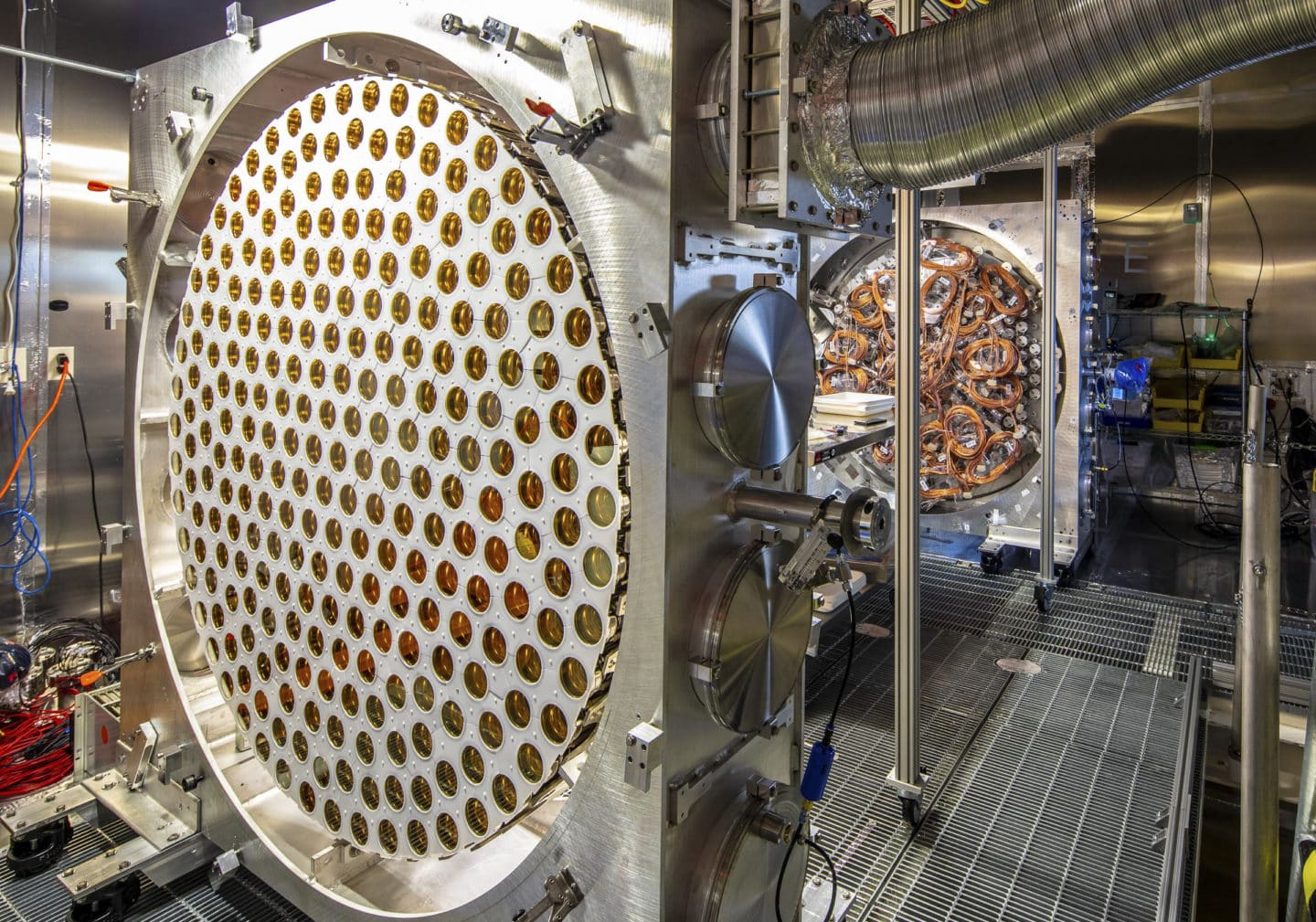
To search for dark matter, LZ uses photomultiplier tubes (shown here before installation in the detector) to capture light from particle interactions.
Our LZ collaboration studies experimental data in batches. In the new result, we analysed 220 live days of data collected between March 2023 and April 2024. The collaboration had previously searched this dataset for faint signals from the simplest kinds of WIMP interactions. The new analysis searched for a broader range of possible WIMP interactions that could deposit more energy in the detector. LZ is particularly sensitive to such signals while also minimising false positives.
“This was a detailed study in a region we hadn’t explored within this dataset, and we spent months of additional effort to understand all the possible causes of background events,” said Sam Eriksen, a senior research associate at the University of Bristol in the U.K. and lead author of the study. “We understand our detector and the backgrounds so well that even a single outstanding event, like the one we found, is important. We expect dark matter events to be extremely rare, so only a handful could mark the first detection of WIMP dark matter.”
If the anomalous event was caused by dark matter, the WIMP that generated it would likely have a mass of at least 200 GeV/c2 (gigaelectronvolts), or more than 200 times the mass of a proton. It would also suggest a specific type of interaction between WIMPs and ordinary matter beyond the simplest model. The LZ results have not reached “5-sigma” significance, the statistical threshold considered a discovery in physics. The new analysis is 2.6 sigma, meaning there is approximately a 0.5% chance that the event could be explained by known backgrounds.
With additional data, we can test whether the finding continues to grow in significance or fades away. LZ has already accumulated the world's largest dark matter dataset and will continue to accrue WIMP search data at SURF, substantially improving their search statistics. The event we have seen, LZ230616, is like a clue in the middle of a crime drama: will this be the one that cracks the case wide open, or a red herring that keeps the investigators on the wrong trail for an episode?
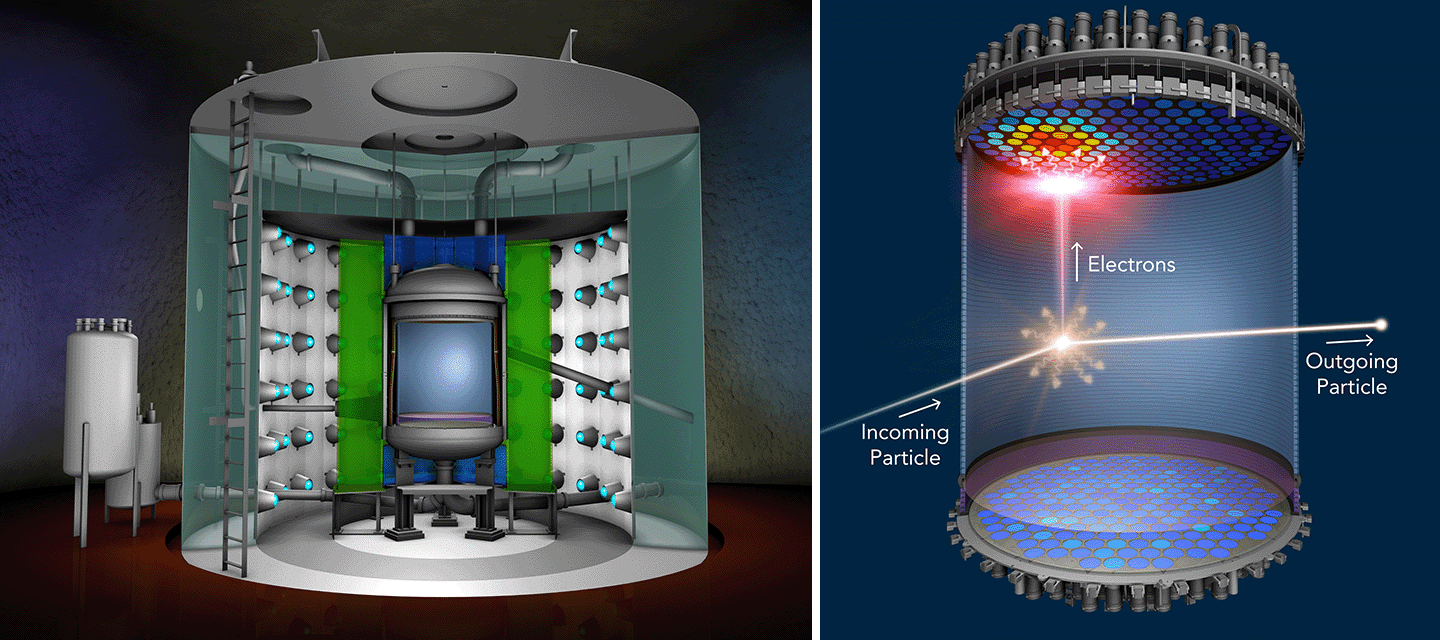
LZ uses a cylindrical chamber full of liquid xenon to search for dark matter. It is surrounded by additional layers to detect or block background particles (left). When a WIMP collides with a xenon atom (right), it emits a flash of light and electrons. The light is detected at the top and bottom of the liquid xenon chamber. An electric field drifts the electrons to the top of the chamber, where they generate a second flash of light.
LZ searches for dark matter by looking for signature flashes of light from energy deposited in the detector. The collaboration leverages multiple methods to prevent or account for particle interactions caused by normal matter. This includes the mile of rock that shields the detector from cosmic rays from space, a water tank and outer detectors that protect the central detector from background neutrons, and a suite of computational tools that disentangle particle interactions and reject dark matter mimics.
To keep the mystery analogy going, these searches don't just end with LZ, but we're working to greenlight our sequel: the planned future detector XLZD. XLZD will continue this technology to search for heavy particle dark matter, as well as the search for neutrino-less double beta decay. A large liquid xenon detector is truly a rare event observatory, and the UK has the opportunity to host this major international facility at Boulby Underground Research Facility, located between Whitby and Middlesborough. XLZD brings together experimentalists from LZ, the competing XENONnT experiment that announced the low energy detection of solar neutrinos on Monday, as well as members of other low background experiments.
As an experimentalist who works to build a large detector and then wait for nature to deliver a new interaction, this week has been a whirlwind of activity. Beyond the experimental announcement, our XLZD leadership in the UK attended a parliamentary debate at Westminster Hall regarding the future of UK Science facilities with a focus on Boulby, and I am now in Geneva attending a meeting of the Astroparticle Physics European Consortium (APPEC), which is working on its future project roadmap. In between, I did an interview for Inside Science on BBC Radio 4.
This whole process has been quite exciting, but in the end, we will need to carefully continue to operate, analyse, calibrate and report on the findings of our LZ detector. A dark matter detective is one who is diligent, careful, systematic and vigilant; traits that Morse, or at least Inspector Lewis, can agree with.
About LZ
LZ is supported by the U.S. Department of Energy, Office of Science, Office of High Energy and Nuclear Physics, and the National Energy Research Scientific Computing Center, a DOE Office of Science user facility. LZ is also supported by the Science & Technology Facilities Council of the United Kingdom; the Portuguese Foundation for Science and Technology; the Swiss National Science Foundation; the Australian Research Council Centre of Excellence for Dark Matter Particle Physics; and the Institute for Basic Science, Korea. Thirty-nine institutions of higher education and advanced research provided support to LZ. The LZ collaboration acknowledges the assistance of the Sanford Underground Research Facility
